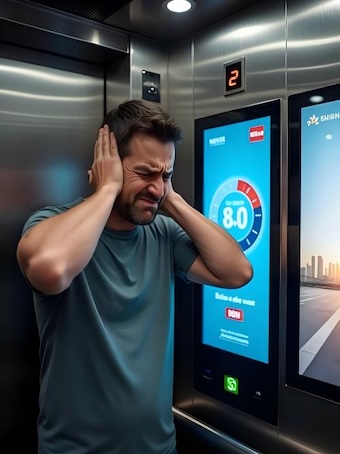
28 year old Shanghai programmer Li Wei's biggest fear every morning is not rushing to time or the elevator being slow, but the 42 inch advertising screen stuck on the wall. The screen plays coffee brand advertisements in a loop, accompanied by piercing music and flickering light and shadow. Every morning feels like a forced advertisement, "he said." I just want to go upstairs quietly. "For countless commuters, elevators are quietly becoming a" forced viewing "advertising theater.
The occupied enclosed space
As property management and property owners continue to seek new revenue models, elevator advertising screens are rapidly spreading to office buildings and residential areas in the city. They are packaged as "free upgrades" and "shared maintenance costs" projects, but most of them were not consulted with residents before installation. The once quiet and neutral space has now become an inescapable 'enclosed advertising room'.
From visual fatigue to emotional oppression
The problem is not only noise, but also psychological exhaustion. The advertising content is played in a loop, often unrelated to the audience - single young people see family packages, and retired elderly people are promoted baby strollers. According to a survey conducted by the China Consumers Association in 2023, 61% of urban residents are averse to elevator advertising, with 38% believing it "interferes with their lives" or "invades their private domain". Li Wei sighed, "In the elevator, you can't walk away, you can't jump over, and you can't turn it off. This feeling of powerlessness is the most frustrating
The opacity behind profits
The property management usually uses "sharing expenses" as a defense, but rarely discloses the destination of advertising revenue. The management fee of Li Wei's community has even increased by 8%, but no one has explained the reason. They said it was to improve the facilities, "he said," but our only 'upgrade' is more advertising
The possibility of returning to tranquility
Experts believe that the core of the problem is not the advertisement itself, but the lack of transparency and choice. Owners can vote to decide whether to install it, or lower the brightness and volume during peak hours in the morning and evening, and even introduce the option of "ad free elevator" for residents to voluntarily pay. Everyone is not against advertising, but against being disturbed, "Li Wei said. Unless this concept is truly implemented, millions of passengers will still spend brief but unavoidable minutes amidst the noise - after all, quietness is becoming a luxury in the vertical spaces of cities.