
As mentioned in the previous article, once sightseeing elevators undertake transportation tasks beyond their intended capacity, efficiency and passenger experience quickly become imbalanced. In actual commercial projects, the deeper issues often lie not in the equipment itself but in the systematic underestimation of the investment-to-return relationship for elevator systems during the planning phase.
Elevator planning is not about "cutting costs whenever possible."
In many commercial projects, elevators are still considered non-core costs. To cut budgets, some shopping centers have reduced the number of passenger elevators, merged functions, or even replaced standard passenger elevators with sightseeing ones. While this approach saves costs in the short term, operational issues such as insufficient capacity, excessively long waiting times, and chaotic traffic flow quickly emerge.
The hidden costs of decision-making errors
Echoing the earlier findings on mall foot traffic loss, the data shows that when the average waiting time during peak hours exceeds 8 minutes, the likelihood of customers abandoning their plans to shop upstairs increases significantly. More critically, subsequent corrections such as installing additional elevators or structural reinforcements often incur costs 2–3 times higher than during the initial planning phase, accompanied by business closures and operational disruptions.
Transport capacity structure determines the business ceiling
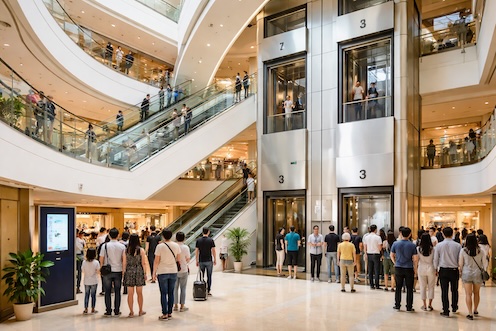
Mature commercial entities focus more on elevator structural configuration rather than individual equipment. High-frequency floors utilize high-speed passenger elevators to ensure efficiency, while experiential elevators serve a display function. Freight elevators and employee elevators operate independently. Through preliminary passenger flow calculations and zoning planning, overall turnover efficiency can be enhanced without increasing the number of elevators.
Treat the elevator as a long-term asset
An increasing number of projects involve elevator professionals in cost calculations during the approval stage to balance investments and returns across the entire lifecycle. Practical experience has shown that reasonable vertical transportation planning offers far greater cost-effectiveness than post-hoc remediation. If you are planning or reviewing elevator solutions for commercial projects, early communication with professional suppliers can often prevent costly "retrospective expenses."