
In addition to the size deviation, certification gray area, and maintenance traps mentioned earlier, an increasing number of cases indicate that even if household elevators are installed correctly, they may still frequently encounter problems during use, and the root cause often lies not in the equipment itself, but in the management and decision-making methods.
Cognitive misconceptions during the usage phase
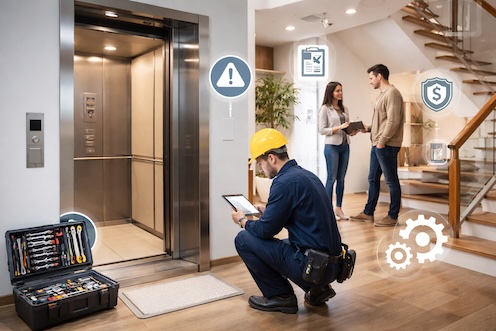
After the elevator is put into use, many homeowners often believe that the project has been "completed" and neglect the subsequent continuous management. In practical use, it is not uncommon to encounter situations such as overloading, repeated power outages, and direct lifting of elevators after prolonged disuse. However, these abnormal behaviors are rarely recorded or intervened in a timely manner by the system, and safety risks accumulate in daily life and are therefore difficult to detect.
The risk amplification caused by ambiguous responsibility
Home elevators often involve multiple parties such as homeowners, family members, property management, and maintenance units, but there is a lack of clear division of labor in practice. Once an abnormality occurs, they often shift the blame to each other and delay the timing of handling. Data shows that over half of household elevator failures are not caused by component damage, but rather chain problems caused by delayed response or improper operation.
The Hidden Costs Behind Low Price Maintenance
Under the pressure of budget control, many families prioritize price factors in maintenance, choose the cheapest service plan, reduce inspection frequency, and even handle seemingly simple minor faults on their own. The problem is not easy to manifest in a short period of time, but as the usage cycle lengthens, the wear and tear of components continues to increase, and operational deviations gradually accumulate, ultimately requiring higher maintenance costs or even early replacement of the entire equipment.
Incorporate elevators into the overall management system of households
More and more practical experience shows that systematically managing household elevators as long-term operating assets is actually more cost-effective. By establishing clear usage standards, designating fixed responsible persons, and constraining maintenance quality with quantitative indicators, not only can operational stability be improved, but overall expenditure can also be effectively controlled in the long run.
If you are planning a home elevator or have already entered the usage phase and would like a comprehensive evaluation of design, usage, and maintenance strategies, please feel free to contact us for a professional solution that is more suitable for your family's actual situation.