
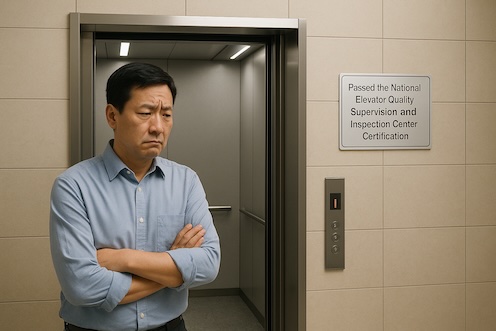
Last early summer, homeowners like Mr. Zhang moved into the newly built community, which should have been filled with joy and anticipation for a new life. However, his excitement was soon replaced by worry. The elevator car shakes significantly during operation, the button response is slow, and the emergency call system often fails. Nearby residents have also encountered elevator accidents multiple times, and the"international brand"elevators promised by the developer are actually only low-end models, far below expectations.
Risks are prevalent
The issue of building new community elevators is not an isolated case. The 2023 Elevator Safety Supervision Report shows that the failure rate of newly built residential elevators is 23% higher than that of old elevators, with 68% of failures due to equipment selection or construction defects. A survey of 50 newly built communities shows that 42% of elevators lack emergency leveling devices, 35% of car heights are below the national standard of 2.3 meters, and 28% of guide rail verticality deviations exceed twice the allowable value. These problems seriously affect safety and operational stability.
The consequences of cost reduction
Developers often use low-priced models to replace high-end elevators, saving about 15% of costs in the initial stage, but increasing energy consumption by 40% and doubling the failure rate. In Hangzhou, an untested elevator trapped people multiple times within six months and ultimately had to be replaced as a whole, costing over 2 million yuan. Other cost cutting measures include replacing stone with plastic patches for the interior of the elevator car, switching from five party communication to mobile communication, and reducing the safety factor of steel wire ropes, which not only affect aesthetics but also threaten safety.
Maintenance difficulties
After check-in, maintenance issues continue to arise one after another. Low price maintenance units often use inferior parts, resulting in frequent elevator malfunctions. The data shows that the first-year major repair rate of newly built residential elevators is 41% higher than the normal level, of which 76% is directly related to maintenance quality. The"all inclusive"contract also has hidden dangers, such as the promised 24-hour response may be delayed, the high cost of replacing core components during shutdown, and the increased burden on the owner.
Positive solutions
Some communities have taken proactive measures. Establish a whitelist of 28 technical indicators to ensure supplier quality, and select mid to high end elevators based on full lifecycle costs, which can save 12% of costs in the long run. Hire a third party to conduct 72 hour continuous operation testing to detect design defects in advance; Utilize the property management app to update maintenance records, faults, and parts replacement information in real-time, promoting maintenance units to improve their service level.
Stable and reliable operation
A few months later, Mr. Zhang found that the elevator was running smoothly and was certified by the National Elevator Quality Supervision and Inspection Center. True quality, like a carefully designed elevator, is hidden in invisible details - it does not require stunning performances, but can provide safety and comfort in daily use.