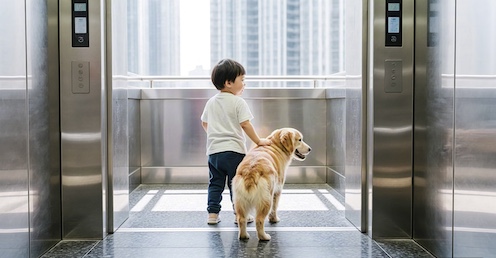
In cities with high-rise buildings, elevators are the "vertical artery" connecting people's lives, but they are also blind spots with hidden risks. Children tiptoeing to press buttons and pets getting caught in door crevices can cause accidents. Data shows that approximately 120000 elevator malfunctions in the United States each year are caused by children accidentally touching them, and 63% of pet suffocation accidents occur unattended, exposing a gap in urban safety awareness.
A shocking scene
Six-year-old Emily from Brooklyn stepped into the elevator with her little dog “Cream Cup.” Just as the doors began to close, the leash slipped into the narrow gap. When the elevator started moving upward, the rope tightened around the dog’s neck, pulling Emily off balance. Luck intervened — the elevator halted on the third floor after detecting an overload, and property staff arrived within minutes to free the frightened pet. Later inspection revealed that the door’s safety sensor reacted half a second too slowly — a tiny delay that nearly turned a routine ride into disaster.
Dual vulnerabilities of technology and negligence
Children accidentally touch the button due to its height and their natural curiosity, and elevators lacking a "child lock" design are more prone to accidents; Pet accidents are often caused by the slow response of anti pinch devices to ropes. At the same time, the distraction of guardians, long ropes, and lack of bilingual warnings also amplify the risks exponentially. The hidden danger of elevator safety often lies not in the equipment itself, but in the negligence of "people".
Reshaping the Security Line
To mitigate risks, it is necessary to work together from three aspects: technology, management, and education. Technically, AI visual recognition, millimeter wave radar anti pinch, and automatic rope removal systems can be promoted; In terms of management, it should be required by legislation to post bilingual warnings, clarify guardianship responsibilities, and have property management conduct regular drills; In terms of education, through VR experience and community promotion, we aim to help the public understand the importance of "safe use of elevators".
Conclusion: Gentle Protection
Elevator safety is a combination of technical precision and humanistic care. From Emily's story to global data, we see not only risks, but also questions about civilization. Only by combining technology, institutions, and education can every rise and fall be more reassuring, and the height of the city truly deserves its temperature.